Dragonfly supported a manufacturing partner on their journey from SAP ECC to S/4HANA – helping lay the foundations for a truly intelligent enterprise. Over a focused six week period, our collaborative system study delivered clear pathways to a digital core that empowers, connects and anticipates needs – so technology works for people, not the other way around.

Laying the Foundation for S/4HANA Transformation
Use Case: Laying the Foundation from SAP ECC to S/4HANA
Industry: Industrial Manufacturing
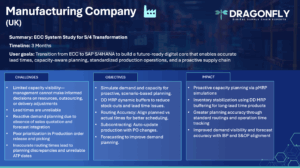
Goals: Establish a modern digital core that provides accurate lead times, capacity-aware planning, standardised production operations and a proactive supply chain.
Timeline: 4-6 weeks
The Challenge
The customer faced several operational roadblocks:
- Limited capacity visibility – making it challenging for managers to optimise resources or make timely decisions on outsourcing and deliveries.
- Unreliable lead times that impacted the ability to meet customer expectations.
- Reactive demand planning that stemmed from the lack of integration between sales quotations and forecasting tools.
- Production order prioritisation was inconsistent, causing issues with releasing and picking processes.
- Inaccurate routing times led to planning discrepancies and unreliable ATP (Available-to-Promise) dates.
Our Approach
We defined targeted objectives to address these gaps:
- Simulate demand and capacity for proactive, scenario-based planning.
- Leverage DD MRP dynamic buffers to reduce stock-outs and address unpredictable lead times.
- Improve routing accuracy by aligning planned versus actual operation times for more reliable scheduling.
- Automate subcontracting updates so production reflects changes in purchase orders in real time.
- Enhance forecasting to enable sharper, data-driven demand planning.
Outcome & Impact
The study provided clear direction in how SAP S/4 HANA could deliver measurable improvements, including how:
- Proactive capacity planning through pMRP simulations could help the organisation to balance workloads and improve decision-making.
- Inventory stabilisation was achievable for long lead-time products by introducing DD MRP buffering.
- Greater accuracy in scheduling could be realised through standardised routings and real-time tracking of operation times.
- Improved demand visibility and forecast precision could be delivered through integrated IBP and S&OP processes.

© Dragonfly Business Solutions Limited I Terms of Use I Privacy Policy